Posts

Garden Tour and Plant Sale Muskogee 6.1.19

Image
Master Gardeners Veggies and More Garden Tour,  June 1, 10 to 3, $10 Plant Sale at Honor Heights Park Papilion  Tickets at Garden Locations Trudy and Sud Sudberry, 2701 North 64th Street West, Muskogee Pam and John Turnbull, 2906 North 24th Street, Muskogee Ruth and David Redding, 106 East Elm, Ft. Gibson ------------------------------ ----------------------------- The Muskogee County Master Gardeners Veggies and More Garden Tour next Saturday will have plenty of unique features to attract gardeners and plant lovers. The tour gardens have annual and perennial flowers, succulents, vegetable gardens and herbs to show and talk about.  At the beginning of each hour there will be talks about gardening topics ranging from raised beds to irrigation and insect control. The Sudberry’s garden is remarkable. A flower and herb garden hugs the house and shed. Down the hill, a fenced vegetable and fruit garden has raised beds, vines and fruit trees. Alon...

Garden Professors Investigate Myths

Image
The Garden Professors are a group of gardeners, extension agents and other scientifically minded gardeners who research and write about gardening, specifically, what is true and what is myth.  One author quotes Will Rogers to explain their purpose. “It’s not what we don’t know that causes us trouble, it’s what we know that ain’t so.” Most of us have been unwitting victims of garden advice that was given to us with an authoritative tone of voice but without any scientific confirmation. Then, it is accepted as fact and repeated. The Garden Professors check out garden myths for us. Examples of their projects at  gardenprofessors.com Weed blocking fabric actually provides a great substrate for weed seeds to take hold. In addition, “all those pores in the fabric that supposedly allow water and oxygen to move through are soon filled with bits of soil.”  Remove the weed cloth and replace it with wood chips. More information -  https://bit.ly/1DgVejP Ep...

Spiderworts Love Shade

Image
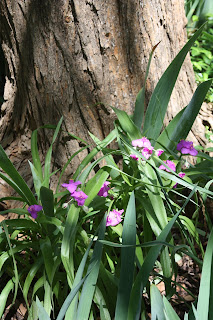
Spiderwort flowers bloom for weeks at the base of deciduous tree trunks and shrubs, tucked among their roots. Each individual flower lasts only a day but there are several waves of little three-petaled flowers that keep the show going.  The most common Spiderwort is the American native Tradescantia virginiana or Woodland Spiderwort with blue and lavender-blue flowers.  Tradescantia ernestaniana, Ernest’s spiderwort, or Red Cloud is native to OK, AL, AR, MO and MS.   Spiderworts are hardy from zones 5 to 9, with flower colors from rose-red to blue and deep purple. They share the same plant family, Commelinaceae, with 731 other so-called perennial dayflowers that originated in Canada and the tropics from the West Indies to Argentina. Other Tradescantias with three-cornered flowers include Purple Heart, Tradescantia pallida and Wandering Jew, Tradescantia tricolor, often grown under trees as an annual groundcover. Spiderworts are easy to grow in avera...

Daisies for Pollinators, Vases and Flower Bed Borders

Image
Daisies are among the most cheerful and reliable flowers for borders and cut flower beds.  Annual Marguerite Daisy, Argyranthemum frutescens, has yellow, pink and red flowers. They do their best when nights are 75 degrees F and below so when they fade with summertime heat, shear them back and they will return in the fall. Annual Painted Daisy, Tanacetum coccineum, grow 2-feet tall in part shade. Remove the faded flowers and they will re-bloom in the fall. Pale pink Eileen May Robinson and James Kelway are easily grown from seed. Gerbera Daisy, Gerbera jamesonii, are from Africa so they are frost-tender and enjoy summer heat with afternoon protection. Festival and Jaguar Series are multi-colored. Gerberas mature at 10-14 inches, do well in containers with regular fertilizer and water. Experienced gardeners may remember when Gerbera Daisy was called Pyrethrum, Painted or Persian Daisy. Shasta Daisy, Leucanthemum x superbum is a garden workhorse that is a cross betwee...

Arboretums for Learning and Walking

Image
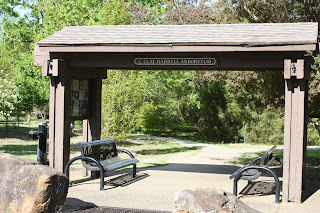
There are dozens of beautiful places to walk and hike in the Muskogee area and the C. Clay Harrell Arboretum at Honor Heights Park is especially nice this time of  year. The trees are filling out and many of them are in bloom.  An Arboretum is a tree collection that is intended as a place to study trees. The first recorded Arboretum was in Croatia in 1492. If you want to add trees to your landscape, visits to an Arboretum provide opportunities to see many varieties at maturity, in flower, with fall color and their winter interest such as decorative bark. A concrete, 3/4 mile path winds through the Harrell Arboretum and most trees are identified with signs. Recently there were flowers on Red Buckeye, American Smoke Tree, Flowering Peach and Amur Maple. The Crabapples are starting to form and the Japanese Maples have bright green new growth. City Arborist Tim Doerner said that Muskogee’s arboretum has 350-400 trees with only a few duplicates. Most of them w...

Virginia Bluebells are Mertensia virginica

Image
Any yard or patio with a bit of shade is a potential home for Native Bluebells.  Mertensia virginica is a perennial gardener’s dream plant. They are cold hardy from zones 3 to 8 with pink-turning-blue flowers for two months, avoided by rabbits and deer, require zero care, and spread slowly to form colonies.  The oval leaves come up early spring, followed by the tiny pink flower buds and then the multiple clusters of  1-inch long, bell shaped, blue flowers.   Virginia Bluebells are ephemeral, meaning that after they flower and the leaves gather nutrients for next year, they disappear completely. Every year, I intend to divide our 10-year-old clump but spring is so busy that they are gone before good intentions become an action item. Many gardeners over-plant their Native Bluebells with Hostas or Ferns but ours are just mulched, leaving their planting area empty the rest of the year.  They mature at 2-feet tall and each plant is about 9-inches ...

Dandelions, Taraxacum officinale have Many Uses

Image
Dandelions, Taraxacum officinale or T. vulgare, are a member of the Sunflower plant family and their spring flowers are a source of nutrition for bees as they emerge in the spring.  When we were growing up in rural southwest Ohio, our grandmother sent us out to collect dandelion greens for her salad, calling them her spring tonic. By example, she taught us old-world nutrition (plus gardening, baking and yoga).  Now that we have food science, it is widely-accepted that 1-cup of dandelion greens contains 25 calories, 500% of the daily recommended vitamin K and 100 % of vitamins A and C. They have been used medicinally for thousands of years. Today Dandelions are widely used in herb teas such as Pukka. The roots are also roasted to use as a chicory coffee substitute and the greens are said to be good for cleansing liver, kidneys, and blood, improving digestion, lowering blood pressure and cholesterol.  The Sprouts Farmers Market chain sells dandelion greens...