Posts

Showing posts with the label Fine Gardening

Divide perennial flowers late summer and early fall
Image
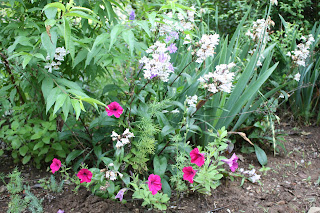
Petunias under Dark Towers Penstemon Plan to divide your favorite spring blooming perennial flower. Before a plant takes over its allotted space and before it falls over from outgrowing its core, take a look at where you could transplant pieces of it where the root cuttings would thrive. At this time of year - after booms have faded in late summer and early fall - you can prune back the entire plant before digging, dividing, and transplanting. After pruning, use a shovel, fork or trowel to cut all the way around the plant's root ball. If the plant is woody and large, digging down far enough may require digging out a trench where you can get enough leverage to lift the roots without too much damage. Outside the drip line is the place to start. The outermost tip of the leaves where rain drips off is the drip line. Perennials make roots in the winter and stems in the spring and summer so dividing and transplanting now will give them ample opportunity to be...

Do you know your gardening myths?

Taking the myths out of gardening is a big topic in the garden writing world. Dozens of articles, books and blog entries have been written about them. Here's a sampling - Renegade Gardener's site is one of the places you can find out what we've believed about gardening that is false, untrue, inaccurate, an old wives' tale, a myth. In a tab called Myth of the Week, Don Engebretson covers the topics: Organic fruits and vegetables are not sprayed with chemicals Trees and shrubs should be fertilized when planted Plants are pre-programmed to grow to a certain size and height Add gravel to containers before planting Your home compost pile can spontaneously combust Rototill your vegetable beds annually Add lime to your soil Fine Gardening's John Fech writes about Nine Myths that include: Fertilize stressed plants Use varnish, tar or paint, to cover recent tree prunings Organic pesticides are less toxic Newly planted trees have to be staked Drought tole...

Angelica Gigas

Image
In the winter of 2007/2008 I bought seeds from Chocolate Flower Farm so I could grow Angelica Gigas. One plant from that seed-starting adventure has survived to grow up. Fine Gardening has this photo of it in a garden. The leaves are gorgeous. It's a biennial so I'm hoping for a flower this year and fresh seeds for next year.  This flower looks like purple broccoli but to the bees it looks like a honeypot! Heronswood catalog has the flower but I don't yet. Plants for a Future's website has this spectacular shot of the bud opening which they borrowed from Wikipedia. Gorgeous, eh? PFAF provides these growing tips Perennial growing to 1.8 m (6ft). It is not frost tender. It is in flower from Jul to August, and the seeds ripen from Aug to September. The flowers are hermaphrodite (have both male and female organs) and are pollinated by Insects.The plant is self-fertile. The plant prefers light (sandy), medium (loamy) and heavy (clay) soils.The plant prefe...

Busy In the Garden

Image
This is a busy season in the garden and most of us are wishing for rain or recovering from rain. Remember spring when it was cool outside and the garden possibilities seemed endless? Summer's heat dashesd some of those spring fed dreams because watering and mulching take up a lot of time and there are so many fun things to do. A new e newsletter from Fine Gardening's Janet Macunovich provides watering ideas worth considering - Excerpts and the link Water makes up 90 to 98 percent of every plant we grow. It holds leaves and stems aloft, just as air in an inner tube keeps a tire round. All the nutrients plants need to grow, color, flower, multiply, and defend their tissues against pests are produced by the solar-powered chemical reactions that take place in the watery soup within the cells. Twenty years of gardening has taught me to ignore generalities .. . The first step when determining a watering regimen is to test your soil's water-holding capacity. First, soak a 12-inch-...

Fall is the Right Time to Divide Perennials

Image
Fine Gardening Magazine's Janet Macunovich has a terrific column on dividing perennials today. (Read about Macunovich here and here . Don't miss that second link - It's how to access her articles online for $25 at practical gardening institute dot com. ) At the Fine Gardening link, Macunovich provides plant division tips with photos of the process plus videos. The basics she covers include: Divide healthy plants in cool weather, starting at the drip line; keep the diggings cool and moist while you amend the soil; use the healthiest parts as transplants, and, spread them widely enough to establish their own root system Scroll down the page for other helpful videos including how to divide plants with taproots, running roots, woody roots, etc. Keep scrolling to find a list of what to divide when and how. It's everything you need to know in order to rejuvenate older plants. When making divisions for your gardens put a few into pots to give as holiday gifts Click here to ...

Plants that Respond Well to Root Cutting Propagation

Aha! Using different search terms I found a Fine Gardening article that lists the plants best suited to root cutting propagation. Written by Hunter Stubbs, horticulturist, writer, landscaper, owner of BB Barns Landscape Company . Stubbs' illustrated instructions will help even those of us who are novices succeed. Click on the link above and choose printer friendly version. These are the plants Stubbs recommended for root cutting propagation. I'm encouraged to try to propagate my Joe Pye Weed. Woody Plants Figs (Ficus carica) zones 6–9 Glory bowers (Clerodendrum spp. and cvs.) zones 7–11 Hydrangeas (Hydrangea paniculata and cvs.) zones 4–8 Lilacs (Syringa vulgaris cvs.) zones 4–8 Mock oranges (Philadelphus coronarius and cvs.) zones 4–9 Oregon grapehollies (Mahonia aquifolium and cvs.) zones 6–9 Pussy willow (Salix discolor) zones 4–8 Raspberry (Rubus biflorus) zones 6–9 Red- and yellow-twig dogwoods (Cornus stolonifera and cvs.) zones 3–8 Rose of Sharons (Hibiscus syriacus cv...