Posts

Showing posts with the label propagate by layering

Making more plants at home

Image
Agastache Many of your favorite perennials can be multiplied right now to make more plants for our gardens. Right now in re-purposed strawberry clamshell containers, I have cuttings from Anise Agastache, Nepeta Walker's Low, Salvia elegans, Lavender and I'm about to start Setcreasea pallida and Huskers Red Penstemon.  Prepare a planting container with moist sand, vermiculite, perlite or sterile potting soil. Take stem cuttings about 4-inches long and remove all but the top few leaves. Make holes in the rooting medium and stick the stems into the hole. Firm up the sand, etc. around the stem. Roots will grow where you removed the leaves so be sure there is a leaf node at the very bottom of your cutting. Nepeta cuttings with tiny roots Shrubs that flower in the spring should also be multiplied at this time of year.  Branch cuttings taken in the spring for the purpose of propagating more plants are called softwood cuttings. Softwood is not the new tender growth shrub...

Carolina Jasmine is Gelsemium sempervirens

Image
Gelsemium sempervirens, Carolina Jasmine is a plant of many names including Carolina jessamine, evening trumpetflower and woodbine. Carolina Jasmine We have never used it medicinally but its history includes to treat measles, tonsilitis, rheumatism, headaches, etc. It is the state flower of North Carolina and is a popular garden plant even though it contains strychnine alkaloids and should not be consumed. Sensitive individuals can get a rash from the sap though I have not. South Carolina says, "Here we refer to it as jessamine since that is how it is spelled in Joint Resolution No. 534, which established the flower as an emblem of South Carolina nearly a century ago.)" The nectar is toxic to honey bees and can cause brood death. Prune after bloom is the usual advice for keeping its size under control. You can see that it thrives in the half day shade provided by the carport. We rarely water or fertilize it and it keeps on going and growing. If you have a vin...

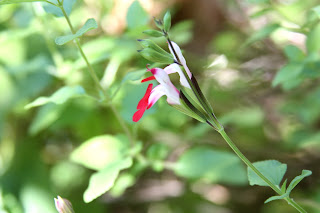
Hot Lips Sage is Salvia microphylla Hot Lips

Image
This particular Salvia has been in our garden for four years. It never really took off like the one in the catalog, but it soldiers on, blooming spring, summer and fall - even past our first frosty nights.   Said to be cold hardy in zones 8 to 10, Hot Lips does reasonably well in our zone 7 since it is protected by close neighbors - A climbing Euonymus on the east fence behind it and an exuberant Lantana on it's west side. In the heat of the summer the sparse flowers are mostly white. Like all Salvias, the scent keeps most predators such as deer at a distance. Salvia microphylla Sage Hot Lips   Plant Delights Nursery offers them in their online catalog at www.plantdelights.com . The catalog says it "was introduced by Richard Turner of California after the plant was shared with him by his maid, who brought it from her home in Mexico. The fast-growing, 30" tall x 6' wide clump is adorned with stunning bicolor flowers with red tips and white lips......