Posts

Showing posts with the label Fall planted bulbs

Fall Planted Bulbs for Spring Flowers
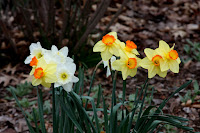
Image
The time to plant spring blooming bulbs has arrived along with an abundance of bulb company catalogs.  Becky Heath of Brent and Becky's Bulbs has an article in this month's American Horticultural Society newsletter. You can read the entire article at this link . Heath says, " There are several approaches to combining bulbs with herbaceous perennials, shrubs, and trees. Choosing combinations that will bloom at the same time creates the biggest impact, like the finale of a fire - works display. Combining plants so that they bloom sequentially with a slight over -plant tulips or lilies eight to 10 inches deep, then above them place daffodils, hyacinths, or alliums at about six inches. Smaller early-blooming bulbs—such as crocuses, anemones, and dwarf irises—can even be planted in the top three inches." Heath's bulb-planting tips The best time to plant spring-flowering bulbs is after the first hard frost. Before then, the soil normally remains warm from the...
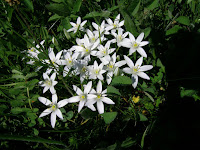
Silver Bells Bulb Planting - ornithogalum umbellatum

Image
Ornithogalum angustifolium Silver Bells have a bad reputation because there are two or more, very similar, flowering bulbs. Some that can become invasive in our zone 7, sort of temperate gardens; others are better-behaved. Ornithogalum nutans &  umbellatum side by side Star of Bethlehem is a member of the lily plant family,  Asparagaceae. It has received plant of merit awards and screams of invasive, depending on the writer. As usual, part of the problem is the lack of in-depth research. Ornithogalum nutans is from Asia and can become invasive. Ornithogalum umbellatum, from Europe, does not. Both are called Star of Bethlehem, Dove's Dung and Silver Bells so check to be sure you plant the one that suits your needs. I ordered O. umbellatum from Old House Gardens Bulbs and planted them in a little spot that has not been cultivated before. The bed is opposite the vegetable garden though so we are over there quite a bit from early spring cultivating through Janu...

First Crocus bloom Jan 27

Image
In the  cold fall months faithful gardeners plant spring blooming bulbs, coming inside to warm their cold-numbed hands between the bags of bulbs and corms that have to go into the ground. When the Crocus bulbs begin to bloom in January and February no matter how cold and snowy the weather, we get our reward. If you did not get any Crocus bulbs in last fall, put them on your calendar for Oct-Nov 2015 planting. Their tiny flowers are guaranteed to bring a smile in late winter-2016. posted from Bloggeroid

Old House Gardens Heirloom Bulbs - order spring flowering bulbs now

Image
Martagon Lily Old House Gardens specializes in heirloom bulbs and we order something from them every fall for October shipping and planting. As the summer begins to fade away, ordering bulbs for spring helps ease the blues caused by the realization that, oh, no, the garden is fading. Here's what I ordered this morning (all photos are from OHG site) Coral lily Martagon lily - European mountain lilies Early flowering, pink turk's cap type flowers, 3-4 feet tall and a bit fussy according to the OHG catalog. Zones 3-7. Prefer part shade. Coral lily - native to Siberia! Zones 4-8. Can be short-lived but self-seeds. Early flowering. White Windflower Anemone - Strong white flower for bright shade in zones 5-8. Here they grow to about 6-inches tall in the mid-spring. Avalanche daffodils/narcissus - grows 16-18 inches tall and has clusters of sweetly scented flowers. It was discovered in Scilly Isles but has grown well in our garden for years. We needed mo...

Crocosmia are coppertips, falling stars or montbretia

Image
Crocosmias are native to South Africa but do wonderfully well here in Northeast Oklahoma anyway. They bloom their little heads off and make babies by the dozens each year, making it possible to move them around the garden to almost every bed except the deepest shade.  Crososmia with a yellow pot marigold The corms are planted in the fall and often bloom the following spring. They can be started from seeds. (Plant in seed trays, about 1/4" deep, in seed starting soil and plant out in the spring. They do have to be divided every few years since they become so thick - they are related to that every multiplying-iris after all. Also related to gladiolus.   Give them lots of sun and some water for best blooming on stems that are about 2-feet tall or less. They do not make good cut flowers as they fade and fall apart quickly after cutting.   Cold hardy in zones 6 to 10, they couldn't be any easier to grow.   Plant Delights catalog says, "Crocos...

Plant Spring Bulbs Now in Pots or Plots

Image
Nothing says spring like a pot or plot of tulips, daffodils, crocus and hyacinths. They are in the stores now because spring blooming bulbs are planted in the fall . Plenty of sun and good drainage are all they need. Though they have been grown in Holland since 1590, tulips came from the near east originally. Because of their formal appearance, tulips look great in rigid beds in lines of color. Purple, yellow, red and parrot tulips can be blended together or planted in banks/stripes of color. Plant early, mid-season and late blooming varieties in separate groups so you have flowering blocks of blooms rather than blotches. While most hybrid tulips are annuals here, the small, non-hybrid (called species), tulips may return. Look for these Species tulips: bakeri, clusiana, kaufmanniana, saxatilis, sylvestris, tarda and whitallii. Daffodils or Narcissus can bloom early, mid-season or late. They are reliable and will multiply. The variety of daffodils grows relentlessly and...