Posts

Pawpaw, Asimina triloba, loved by Zebra Swallowtail Butterflies

Image
The flowers of Pawpaw, Asimina triloba, are downward facing so you have to keep an eye out for them or you will miss their sweet beauty in the spring. Ours is blooming now and has been for the past 2 weeks.   In order to get fruit, you have to have 2 cultivars. We don't care about fruit since we planted the tree solely for the zebra swallowtail butterfly's visits. For our purpose a seed started tree was just fine. For fruit, look for grafted cultivars.   Some protection from the worst of summer's sun and excellent drainage are critical to their success. Since it is a small tree, ours is in the herb bed with a bird bath and a few native plants.           KY State University Pawpaw Planting Guide is at this link   Excerpts- "The pawpaw is a tree of temperate humid growing zones, requiring warm to hot summers, mild to cold winters, and a minimum of 32 inches (81 cm) of rainfall spread rather evenly throughout the year...

Erica Glasener at Flower Garden Nature Society of Northwest Arkansas

Image
Atlanta GA is the home of HGTV personality and author Erica Glasener (ericaglasner.com) who gave two talks at the Flower Garden and Nature Society last Saturday. Program chair for FGNS, Gail Pianalto, introduced Glasener as “a rock star of the gardening world”. In her recent past Glasener hosted “A Gardener’s Diary” on HGTV for 14-years, interviewing gardeners across the U.S. Her list of writing credentials include a garden column in the Atlanta Journal-Constitution, Southern Lady Magazine, Fine Gardening, and many others. Her books include “Proven Plants: Southern Gardens” and her planting tips are part of the Southern Living Plant Collection website at southernlivingplants.com/expert_advice. Glasener opened her first talk by saying that she thinks the soul of any garden is the gardener who works there. She is also a plant-lover who thinks native plants are perfect but that imported plants and hybrids are also quite important in a garden. The morning talk included doz...

Perky-Pet birdfeeder

Image
Perky-Pet birdfeeder is hanging in our back yard now on the squirrelliest tree we have.   This oak produces hundreds of acorns, making it the biggest challenge for any bird feeder that claims to prevent squirrels from eating everything in it. The birds have visited but I have not seen one single squirrel on it and it's been hanging for several days. This item I can enthusiastically recommend. The plastic food holder is thick enough to not fall apart in one season. The perches please the birds, the seed that came packed with it attracts plenty of visitors and the scoop is built to fit the opening. Oh, and the assembly instructions enclosed in the box are easy to understand. In English rather than English translated from Chinese, Japanese or Mandarin. Illustrations complete the instructions ease. It looks like the same company has hummingbird feeders and wind-art. Check them out at http://www.birdfeeders.com  - 40% off hummingbird feeders right now.

Landscape Paintings by Prince Charles

Image
Called "Life in Pictures" the link on Prince Charles website showing 130 of his landscape paintings is at http://www.princeofwales dot gov dot uk/life-in-pictures   Many famous people paint for recreation and some try to sell them - not just for charity like Prince Charles has done but for profit. The Daily Mail has a collection of them at http://www.dailymail.co.uk/home/moslive/article-2260183/David-Bowie-Prince-Charles-Ronnie-Wood-Can-match-art-celebrity.html  

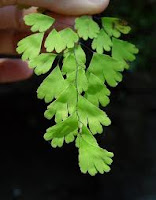
Southern native Maidenhair Fern is adiantum capillus veneris

Image
Missouri Plants Would you like to add a fern to your shade garden that will survive? How about a native Maidenhair Fern, also called Five-Fingered Fern? Part-shade to full-shade will keep it happy and coming back and it will tolerate but not thrive in deep, dense shade. Leaves scorch in direct sun. Maximum height is about one-foot and unlike many ferns, it's water needs are rated as medium - needs consistently moist soil. Not drought tolerant. Native in most of the southern half of the U.S., Missouri Botanical Garden says it is cold hardy from zones 5 through 8. There are 200 Adiantum, Adiantaceae family, ferns in the genus. They all have the same fronds, usually with black, glossy petioles (leaf stems) and fan-shaped leaflets. Their Rhizomes (their crawling underground stem that holds the roots and lives from season to season) are scaly. Check out the Hardy Fern Foundation for more selections at http://www.hardyferns.org . Under favorable conditions...

Glasshouses - history, residences and growing houses

Image
Glass-houses have been used for growing plants in a controlled environment since ancient Roman times but, the most famous glass house was designed by architect Philip Johnson in 1949 to use as his residence. Today it is a national landmark, open to the public. Another glass residence, the Farnsworth house in Chicago, was built by architect Lugwig Mies van der Rohe in the 1940s for Dr. Edith Farnsworth. It is also a national landmark and open for tours. Block Building at Nelson-Adkins Museum  Steven Holl’s addition to the Nelson-Atkins Museum of Art ( www.nelson-atkins.org ) in Kansas City, MO, consists of five interconnected frosted glass boxes in the sculpture park. At night the Block Building resembles paper lanterns in the grass. The glasshouses used to grow plants rather than to house people and art, date back to ancient Egypt where they were used to grow grapes as early as 4,000 B.C. By 300 B.C. glasshouses were heated by manure pits and by 92 B.C. in Italy, ...

Going Wild in the kitchen with foraged greens

Image
When we were kids growing up in rural Ohio, our grandmother sent us out for wild salad greens in the spring and summer. That was (ahem) years ago and foraging is back in style in a big way. The Oregonian reports that Portland urban forager Becky Lerner's 'Dandelion Hunter' explores city's edible weeds, teaches classes and writes a blog about it. Oh, and did I mention a book? Lerner loves plants, but her relationship with the botanical world is far different from that of the avid gardener or arborist. The Portland-based urban forager's interest is in the wild plants that choke out neglected lawns and creep up chain link fences in vacant lots. Where most people see signs of neglect and decay, Lerner sees a meal. In her new book, " Dandelion Hunter: Foraging the Urban Wilderness ," Lerner aims to extend her enthusiasm for untamed nature to a broader audience. "It was really important for me to get some of those ideas out there," she says. ...