Posts

Meadow Pink Texas Star Sabatia campestris Sabatia angularis

Image
Meadow Pink is a small, native, annual, pink-flowering plant found primarily in the southern US. Its other common names include Rose Gentian, Prairie Rose-gentian, Texas Star and Prairie sabatia.  The five-petaled flowers are an inch or two across and the plants are one to two feet tall. Meadow Pinks spread by seed to form colonies. The challenge is to leave them alone during spring weeding since the new rosettes pop up where you least expect them and are easy to forget from year to year. Sabatia prefers dry garden soils that have good drainage; a sandy place would be perfect. Sabatia angularis, Rosepink, is available from seed companies (www.prairie  moon.com ). It is also a Gentian, sometimes called Marshpink, Bitterbloom, Rosepink and Rose Gentian. Sabatia kennedyana, Bog Sabadia for wetlands, seeds are available from  carniverousplantnursery.com Sabatias are biennials, They grow a rosette of leaves the first year, then have pink, gold and magenta flowers on multi-br...

Mother of Thyme for Garden and Kitchen

Image
Thyme is valuable as a kitchen herb, feeds pollinators and makes a terrific ground cover.  Creeping Thyme, Thymus serpyllum or Thymus praecox, also called Wild Thyme and Mother of Thyme, is a European native.  Cold hardy in zones 4-8, its wiry stems and woody trunk take most garden conditions.  Thyme from the grocery store, is probably Thymus vulgaris, but I use Mother of Thyme for marinades, cooking and canning.  The leaves are tiny, blue-green, opposite, and about 1/4th inch long. The stems that create the foliage mat, spread by rooting in soil or sand along their path. The plants are covered with 4-to-6-inch tall stems of tubular flowers right now. Dozens of tiny bees and other insects cover them daily from now until fall. After the flowers are spent, the flower heads can be removed to re-shape the plants. Mother of Thyme is easy to grow in dry to moist, well-drained soil, without fertilizer. We have it planted in four locations around the garden where the soil is...

Jewels of Opar Limon

Image
Jewels of Opar, Talinum paniculata, is a native Central and North American edible plant similar to summer or Malabar spinach. The leaves of the Limon variety are bright green and the flowers form a spray of pink above them on long wiry stems, leading some to call them Pink Baby’s Breath. When the flowers fade, they are replaced by tiny, jewel-like fruits that resemble precious stones.  Southern Seed Exposure first planted Jewels of Opar seeds in 2014 and much to their surprise, the tiny flowers fed pollinators and the edible leaves tasted “surprisingly” appealing ( https://bit.ly/2JmtDK1 ).   Jewels of Opar Limon is very easy to grow. We started with a single 4-inch pot 6 years ago and the seeds have made new plants every spring since then, with no effort on our part. They grow in full sun to part-shade and require minimal water. Almost any soil will do; rabbits, pests and diseases leave them alone except for a small nibble here or there. Jewels of Opar is an old-fashioned gar...

Norfolk Island Pine Tree tabletop holiday decor

Image
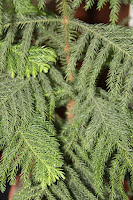
Captain Hook landed on Norfolk Island around 1772 and was impressed by the 100-foot tall evergreens that populated the coastline. When he sent specimens back to England, botanists gave them the Latin name of Araucaria excelsa heterophylla but their common name has always been Norfolk Island Pine. The little Norfolk Island trees we grow as houseplants are actually slow-growing seedlings. They are not  pine trees but acquired the name because they resemble pines. In Camarillo CA where they can grow outside all year, one tree measures 109 feet tall with a 65-wide crown. In our zone 7 weather they are grown in containers and brought inside before freezing temperatures arrive in early winter. We keep our Norfolk Island Pine on the back porch in the summer where it receives bright, filtered light, then it comes inside for the winter where it doubles as a holiday tree decorated with tiny angels.  It is an easy plant to take care of since it needs no pruning, but it does require b...

Plants Saved WWII - Judith Sumner

Image
MUST-HEAR TALK Free and open to public Plants Go To War: A Botanical History of World War II July 8, 7 pm, Tulsa Garden Center Judith Sumner speaking Info Sandy Dimmitt-Carroll 918.693.9416 Today, many medications are manufactured in China but in the years leading up to the war, they came from Amsterdam. When Germany seized Holland, herbs were compounded as replacements.  During WWII small gardens were planted across the US and England to feed the people at home, resulting in 40% of Americans’ food coming from Victory Gardens. US-produced meat and crops went to the troops while vegetarianism soared to 95% on the home front.  In a recent telephone interview, author Judith Sumner talked about her new book, “Plants Go to War”. Sumner grew up hearing about plant compounds, rubber scarcity, synthetic tires, synthetic chewing gum for soldiers’ ration packs, and more, from her father who was an Army chemist. Sumner’s book outlines WWII agriculture, from identifying...

Gooseneck Loosestrife or Icicle Speedwell or Culver's Root Light Up Shade

Image
Gooseneck Loosestrife, Lysmachia clethroides, is one of those plants that generates an emotional reaction among gardeners, with responses ranging from appreciation to a level of dread akin to seeing Frankenstein on Halloween.  This maligned Lysmachia came from China and Japan and loves the growing conditions in the US so much that it enthusiastically spreads out its rhizomes throughout the beds where it lives.  It is a perennial that disappears during the winter and returns double its size the next spring. The plants are 2 or 3-feet tall and have a characteristic plume of flowers in June or July, depending on where in its zone 3 to 8 range it is growing. In a wild or difficult shady to part-shade location the white flowers light up the darkness and experienced gardeners understand that they may have to control its spread each spring by removing plants that stray from their intended spot.  They prefer moist soil and thrive near ponds or wet meadows and naturalize there. Th...

Native Elderberry is Sambucus Canadensis

Image
One plant resource calls native Elderberry, Sambucus Canadensis, a multi-purpose plant, and indeed it is. The flowers feed pollinators, the berries feed birds, the shrubs provide habitat and humans have used the plant in dozens of ways for hundreds of years.  Loaded with vitamins A, B and C plus some iron, the black, blue or red berries can be made into juice, concentrate, wine, jelly and medicinal concoctions. Although wildlife enjoys it, the raw fruit should not be consumed by humans.  Elderflower water was on Victorian women’s dressing tables. They used it for baths and to maintain a soft complexion.  Elderflower tea was thought to calm the nerves, purify the blood, treat bronchitis and cure measles. Commercially available Elderflower syrup is made from a flower extract. In Romania a beverage called socata is made by brewing the flowers with water, yeast and lemon, then fermenting it to create carbonation. Coca-Cola’s version is called Fanta Shokata. Elderbe...