Posts

Arboretums for Learning and Walking
Image
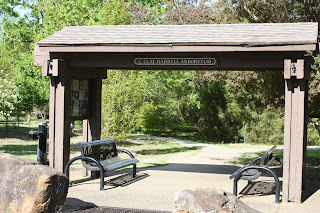
There are dozens of beautiful places to walk and hike in the Muskogee area and the C. Clay Harrell Arboretum at Honor Heights Park is especially nice this time of  year. The trees are filling out and many of them are in bloom.  An Arboretum is a tree collection that is intended as a place to study trees. The first recorded Arboretum was in Croatia in 1492. If you want to add trees to your landscape, visits to an Arboretum provide opportunities to see many varieties at maturity, in flower, with fall color and their winter interest such as decorative bark. A concrete, 3/4 mile path winds through the Harrell Arboretum and most trees are identified with signs. Recently there were flowers on Red Buckeye, American Smoke Tree, Flowering Peach and Amur Maple. The Crabapples are starting to form and the Japanese Maples have bright green new growth. City Arborist Tim Doerner said that Muskogee’s arboretum has 350-400 trees with only a few duplicates. Most of them w...

Virginia Bluebells are Mertensia virginica

Image
Any yard or patio with a bit of shade is a potential home for Native Bluebells.  Mertensia virginica is a perennial gardener’s dream plant. They are cold hardy from zones 3 to 8 with pink-turning-blue flowers for two months, avoided by rabbits and deer, require zero care, and spread slowly to form colonies.  The oval leaves come up early spring, followed by the tiny pink flower buds and then the multiple clusters of  1-inch long, bell shaped, blue flowers.   Virginia Bluebells are ephemeral, meaning that after they flower and the leaves gather nutrients for next year, they disappear completely. Every year, I intend to divide our 10-year-old clump but spring is so busy that they are gone before good intentions become an action item. Many gardeners over-plant their Native Bluebells with Hostas or Ferns but ours are just mulched, leaving their planting area empty the rest of the year.  They mature at 2-feet tall and each plant is about 9-inches ...

Dandelions, Taraxacum officinale have Many Uses

Image
Dandelions, Taraxacum officinale or T. vulgare, are a member of the Sunflower plant family and their spring flowers are a source of nutrition for bees as they emerge in the spring.  When we were growing up in rural southwest Ohio, our grandmother sent us out to collect dandelion greens for her salad, calling them her spring tonic. By example, she taught us old-world nutrition (plus gardening, baking and yoga).  Now that we have food science, it is widely-accepted that 1-cup of dandelion greens contains 25 calories, 500% of the daily recommended vitamin K and 100 % of vitamins A and C. They have been used medicinally for thousands of years. Today Dandelions are widely used in herb teas such as Pukka. The roots are also roasted to use as a chicory coffee substitute and the greens are said to be good for cleansing liver, kidneys, and blood, improving digestion, lowering blood pressure and cholesterol.  The Sprouts Farmers Market chain sells dandelion greens...

50,000 Daffodils at Bartlett Arboretum

South of Wichita - A Must See Event Next weekend, April 13 and 14, historic Bartlett Arboretum will open for a tulip festival with 100 vendors. In addition to live music, art and good eats, there will be activities for children, including Teeny Tiny Town and Story Walk.   The gardens alone are worth the drive to Belle Plaine KS, just north of the Oklahoma state line and 30 miles south of Wichita. Dozens staff and volunteer groups have been working on the grounds to show off the 50,000 tulips that were planted last fall. Bartlett has shade gardens, a lake with an original bridge, a creek-side walk, an historic home and train depot, outdoor concert amphitheatre with lawn seating and a new Victory Garden and hoop house. Robin Macy and her husband Kentucky White bought the shuttered property in 1997 and have invested their hearts, energy, math teacher salary, and musician incomes into Dr. Bartlett’s 1914 home. Still active in their music careers, both played w...

Henbit is Blooming Everywhere!

Image
Wherever you drive now, you see patches of Henbit’s lavender and purple flowers on purple stems.  Henbit can be confused with Purple Dead Nettle (Lamium purpureum) though Henbit has heart-shaped leaves and Purple Dead Nettle has triangle shaped leaves that cluster in clumps. Both are winter annuals that get their start in the fall, form a small rosette of leaves in the winter and then have those carpets of flowers in the spring. Seed formation follows and the plants die in the summer. Henbit leaves are high in iron, vitamins and fiber; it can be boiled, then cooked with butter, spices and a sour cream white sauce. Highly valued by foragers, Henbit and Dead Nettle are added to smoothies, cooked and eaten raw. Henbit is also eaten by some animals and can cause ‘staggers’ in sheep, horses and cattle. Henbit’s Latin name is Lamium amplexicaule, with amplexicaule meaning clasping, or, how the leaves clasp the stems. Lamium is from Lamia, a Greek mythology creature name as s...

My Seed-Startging Tips

Image
There are dozens of lists of seed-starting tips out there. Here are mine.  Seeds packaged for the current year are most likely to germinate, or come up, with healthy sprouts. Planting instructions on the package indicate planting depth, sun requirement, soil temperature, how far apart to plant, etc. Many online resources such as  https://parkseed.com  have  ‘Know Before You Grow’ tip sections. For best germination results, plant seeds in sterile soil in containers or in a well-prepared bed. We start seeds in those greenhouse-imitating, clear plastic, clamshell containers from strawberries or other fruit. Mark each container or row with seed type and planting date. Soak or scarify large seeds, provide cold treatment, etc. according to the directions.  Add no fertilizer;  seeds have everything they need. The first leaf or set of two leaves are called cotyledon. Grasses (monocots) have one; most other plants have two tiny leaves on their fi...

Grow A Scented Garden

Image
Using plants with scented flowers, leaves and stems adds another reason to go outside, even on the hottest days. Of course, we think of Lilacs, Mockorange, Roses, and Flowering Tobacco but there are so many more that add to the experience of being out in the yard, on a patio, or in public gardens.  Many annual, perennial, woody and herbaceous plants call out to be touched. It is irresistible to reach out and touch Basil, Borage, Lavender, and Parsley, or, to stop and smell Pine, Mint,  Jasmine, Rosemary, Alyssum, Dianthus, and Thyme.  And, the scent of spring bulb flowers such as Hyacinths, Daffodils and Fritillaria all make us bend to their height. Several scented plants bloom only at night and are pollinated by moths. Datura is a favorite because it begins to unfurl late in the afternoon and will bloom while you stand there for a few minutes.  The visually impaired and children are drawn to a scented garden. Sometimes new hybrids of old fashioned plant...