Posts

Poinsettia Season is Here

Image
Borovetz Carson Greenhouses, 3020 North St between South Country Club and York Mon to Sat 10 to 6 and Sun 12 to 6    Information 918.682.4404 and 348.1270 Poinsettias are a universal symbol of the holidays in the US, appearing on cards, in arrangements and of course, live plants. Poinsettia  leaves or bracts come in red, white, pink and marbled. The flower is a tiny green center that is barely noticeable. When selecting live plants, look for bright, wilt-free leaves, and unbroken stems.  The tiny flowers should be mostly pollen-free. Buy wrapped Poinsettias on your way home from shopping since even brief exposure to cold can cause damage.  Pete Carson has opened sales of his Muskogee-raised Poinsettias at Borovetz Carson Greenhouses. In addition to a variety of leaf colors, he has four sizes  - Pixie is 4.5 inches with 1 plant.  - 6.5-inch pots have two plants - Eight-inch pots have 3 plants that make a taller display used ...
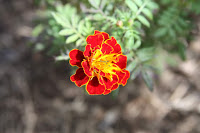
Marigolds or Tagetes can be Dwarf or 16 inches tall

Image
Marigolds, or Tagetes, are one of the most cheerful plants that are easily grown from seed in the spring. Their ease and variety make them a good choice for children and family gardens. Since the plants die with the first freeze and return from seed each spring, this fall’s seeds can be collected to start indoors. The plants will drop their seeds in the garden now and come up next season. You can transplant the seedlings around your other flower beds and containers or just thin them out. Since they bloom all the way to our first hard freeze, Marigolds make a good cover for bulbs and daylilies that have faded for the season. Scientific experiments have recently disproved Marigold’s ability to repel garden pests so just plant them for their beauty.  Nutrient-rich Marigold flowers attract pollinators and can be used as a saffron substitute or to make tea. When you see Marigolds used as an ingredient in medicinal creams, it is the Calendula variety that is high in antiox...

Pawpaw Trees Have Three Season Beauty

Image
In the 1500s the large fruits of  Pawpaw trees fed Hernando DeSoto’s conquistadors during their expedition in the Mississippi Valley. A favorite food of American Indians at the time,  early settlers used the fruit to make jelly. The trees’ inner bark was used to make cloth and to string up fish. Pawpaw trees have a wide native range from New York and Ontario to Iowa and Texas.  The trees mature at 10 to 20 feet tall and wide with a round, upright pyramid form that requires no shaping. Pawpaws are cold hardy to zone 5 so they are quite happy in our zone 7 weather.  The pink flowers in the spring are very pretty and prolific. After pollination, yellow fruits form to ripen later in the summer and fall. The fruit is said to taste like bananas though ours is always eaten by wildlife long before we can harvest any. The leaves are large, light green ovals that turn lime green and then pale yellow in the fall, adding to November color in the garden.  ...

Aster Tataricus Fall Beauty

Image
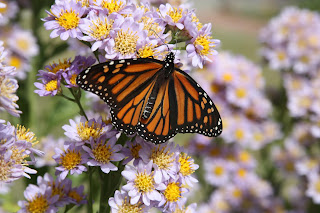
Fall is for asters and they are popping up in lawns at 2-inches tall and in gardens topping out at 10 feet tall. In between there are dozens of other Aster heights to chose from when deciding which ones to plant.  Aster Tataricus is large, with toothed leaves and hundreds of light blue flowers with yellow centers. This variety spreads, creating colonies and providing October-November nectar for hundreds of butterflies. In a sunny location, a cluster of Aster Tataricus can have 20 Monarch butterflies at a time, swaying in the breeze on the Asters’ strong stems while sunbathing and collecting strength to continue their voyage south.  For the most part the stems can stand without staking but when we have a big wind and rain storm they will fall over. Usually, we do not bother to stake them since the skippers, butterflies and bees cover the flower heads just as much. Even though the flowers are only an inch wide, the large clusters are a beautiful addition to fl...

Panolas are Hardier Pansies

Image
The gardening tradition of planting Pansies in the fall got a fresh start with new and improved hybrids. Panolas are just one of the new Pansy hybrids that are now available.  Garden gurus crossed Violas with its tiny spring flowers and our beloved Pansy with its large, colorful blooms. Nurseries are selling them as Panola, Matrix, Dynamite and Universal Plus. The new plants require no removing of the old flowers (dead heading) in order to keep them blooming. Plus, they have greater heat tolerance, sticking around to bloom when the temperatures get too warm for traditional Pansies. Ours, in the photo, came from Riddle Plant Farm in Broken Arrow. They are also available through mail order nurseries such as Burpee (www.burpee.com). Egemont Seed Company (www.Egmont seeds.co.nz), describes Panolas as having flowers larger than a Viola and smaller than a Pansy but with hundreds of flowers that will not be smashed by rain, hail or wind. Compact Panolas are cold hardy in zones 6 t...

Tithonia Torch Flower Mexican Sunflower

Image
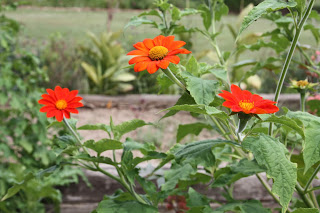
Husky and coarse with spectacularly gaudy flowers is how one garden reference describes Tithonia. Well, they are tall and open branched with stems as thick as a small tree, but oh, how the butterflies love those gaudy flowers. Every sunny hour of the day this month, assorted butterflies will be sitting on the flowers while swaying in the wind on Tithonia’s sturdy branches.  Tithonia rotundifolia has a few common names: Torch Flower , Golden Flower of the Incas and Mexican Sunflower but the seed packets say Tithonia.   Many of the nectar-providing flowers that are  blooming now are members of the Aster or Asteraceae plant family.  Tithonia is in the Sunflower tribe of the Aster family. Their native range goes from Central America, through Mexico and into the Southwestern US. There are several varieties but T. rotundifolia or Torch is the only one that shows up in the flower seed racks in the spring.  It grows 6-feet tall and 3 feet wide by the...

Clematis You Need - You Need Clematis

Image
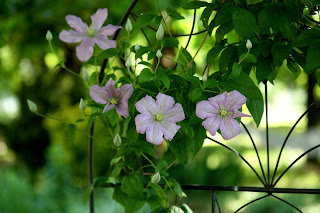
We have two Clematis vines in our garden that bloom reliably in May. A third one blooms every few years when it feels up to the task.  Clematis Silver Moon in May The 3,000 Clematis cultivars have varying flowering times, shapes, sizes, colors and growing habits. Colors range from white to red and purple. Vine lengths vary from 3 to 15 feet. Most of us are familiar with spring blooming Clematis and look forward to hundreds of buds forming on our long-lived vines every year.  Most varieties need 6-hours of sun but want shaded roots in our area. Regular, deep, watering in soil that drains well will keep the roots healthy. Single, double, bell, saucer, tulip and star shaped flowers are available. The vines needs support from a fence, trellis or nearby shrubs. Look for fungus and disease resistant varieties.  Group 1, spring-blooming Clematis grow on last year‘s shoots in sheltered sun. Examples: Rebecca (large red), Josephine (mauve pink with  plum...