Posts

Panolas are Hardier Pansies

Image
The gardening tradition of planting Pansies in the fall got a fresh start with new and improved hybrids. Panolas are just one of the new Pansy hybrids that are now available.  Garden gurus crossed Violas with its tiny spring flowers and our beloved Pansy with its large, colorful blooms. Nurseries are selling them as Panola, Matrix, Dynamite and Universal Plus. The new plants require no removing of the old flowers (dead heading) in order to keep them blooming. Plus, they have greater heat tolerance, sticking around to bloom when the temperatures get too warm for traditional Pansies. Ours, in the photo, came from Riddle Plant Farm in Broken Arrow. They are also available through mail order nurseries such as Burpee (www.burpee.com). Egemont Seed Company (www.Egmont seeds.co.nz), describes Panolas as having flowers larger than a Viola and smaller than a Pansy but with hundreds of flowers that will not be smashed by rain, hail or wind. Compact Panolas are cold hardy in zones 6 t...
Tithonia Torch Flower Mexican Sunflower

Image
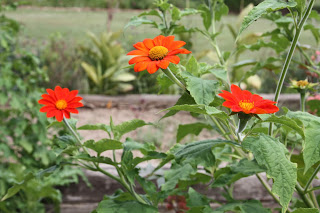
Husky and coarse with spectacularly gaudy flowers is how one garden reference describes Tithonia. Well, they are tall and open branched with stems as thick as a small tree, but oh, how the butterflies love those gaudy flowers. Every sunny hour of the day this month, assorted butterflies will be sitting on the flowers while swaying in the wind on Tithonia’s sturdy branches.  Tithonia rotundifolia has a few common names: Torch Flower , Golden Flower of the Incas and Mexican Sunflower but the seed packets say Tithonia.   Many of the nectar-providing flowers that are  blooming now are members of the Aster or Asteraceae plant family.  Tithonia is in the Sunflower tribe of the Aster family. Their native range goes from Central America, through Mexico and into the Southwestern US. There are several varieties but T. rotundifolia or Torch is the only one that shows up in the flower seed racks in the spring.  It grows 6-feet tall and 3 feet wide by the...

Clematis You Need - You Need Clematis

Image
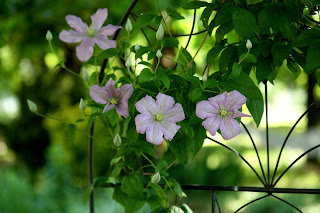
We have two Clematis vines in our garden that bloom reliably in May. A third one blooms every few years when it feels up to the task.  Clematis Silver Moon in May The 3,000 Clematis cultivars have varying flowering times, shapes, sizes, colors and growing habits. Colors range from white to red and purple. Vine lengths vary from 3 to 15 feet. Most of us are familiar with spring blooming Clematis and look forward to hundreds of buds forming on our long-lived vines every year.  Most varieties need 6-hours of sun but want shaded roots in our area. Regular, deep, watering in soil that drains well will keep the roots healthy. Single, double, bell, saucer, tulip and star shaped flowers are available. The vines needs support from a fence, trellis or nearby shrubs. Look for fungus and disease resistant varieties.  Group 1, spring-blooming Clematis grow on last year‘s shoots in sheltered sun. Examples: Rebecca (large red), Josephine (mauve pink with  plum...

Fall Cuttings Make More Plants

Image
Willow Tree Cutting Every year around this time I take cuttings of plants that I want to have more of next year, including Coleus, Brown Turkey Fig, Pineapple Sage, Nepeta Walkers Low and Forsythia. Plus, I take cuttings of plants that have done well over the last few mild winters but may not thrive in a colder year. That list includes Lavender, culinary Sage, Rosemary and Flowering Quince. This year I want to try Viburnum because the variety we have is loaded with flowers and pollinators in the spring. Growing plants from stem cuttings is the most common propagation method and the steps are not complicated. You will need sharp cutting tools, such as pruners, that have been cleaned with 10 percent bleach solution or rubbing alcohol. Fill clean planting containers with planting medium such as sand, vermiculite, perlite and/or potting soil. Water and allow it to drain. Forsythia shrub cuttings  To make a flower pot greenhouse, insert chopsticks into the soil and cover...

Beautyberry Shrub is Callicarpa americana

Image
Like many native shrubs, Beautyberry is shunned by gardeners who want a formal appearance to their property. If you can enjoy the more rustic look that comes with native plants, though, Beautyberry is a star of the fall hedge row in zones 6 - 10.  Beautyberry, Callicarpa Americana, or French Mulberry, enjoys sun to part shade, has minimal water requirements and is disease free. Our row of them is tucked under native peach trees along with holly shrubs for fall migrating birds and fennel for butterflies. Many species of birds enjoy the berries but rabbits and deer rarely eat the stems or leaves. Callicarpa also comes in other varieties with white and lavender berries. Callicarpa Americana takes its time growing to the mature size of 5 or 6 feet tall and wide.  The tiny pink-white flowers attract lots of pollinators in late spring. If you have a Beautyberry that you want to move or divide, do that between Nov and Feb during dormancy. Prune out dead branches and sh...

Green Horizons Newsletter

Green Horizons newsletter reprints articles of interest they have collected. The link will take you to the September 2018 issue. https://mail-attachment.googleusercontent.com/attachment/u/0/?ui=2&ik=ae8ccb1781&attid=0.1&permmsgid=msg-f:1611979581610844608&th=165ee6e38b18e1c0&view=att&disp=inline&saddbat=ANGjdJ8yGnaMKpOPQK3TdrXT8bZZjDxZu8K83ozh9cBUp3EXiG0XGsvxLWFt1sAnK16s_z0mNEDOjqTSEKk5qSm2Q-WZIkF2YsYCCi_znlBbcPvU15O102Kx_3z-SGg-Jd0H8Vwta6sIyaqgDbyu3hmOuY7-pq7JXRgtZ4HP3sJ1ZhO6GvoHzgQqm_t_Xvs1haTT4_Rmem9qvoUevu60vnD541_mjNPZ5KbytIUw-wwKFao_Bciy9dce2JrxkMcu5PKkWfc8Q6iQtigmhHGZIRiBzHwdFn-jQciBc-sA_r5QdoLIyG0RQbTzs-3hiN0oH9xO5EM-UvfM7dpDylTA9SJmle0wOXGdsfjzG6dYiehXYlTBZC7FhbOqZ3ufRFDOgxeRcSsMa7Y-moBplYwbxZIhqc5jUe9S1So69_V3GecVG4ihGZF6Eqe3iYI_xJunN3Gfj_9AIEoAKns-pPo7063O3WYUMHLb5PIEfjA6KRPKggQM-zXbsfUD0t1sxnUaiM1kUU-zEG87nzOs6CQsxIk_TzjZ5hzIgJaYMV48Ut61ZvpH2OVmDQ3I8xr5Nsjo5PKoOwOah0cNdLjARkogOk9WsO6dXeMcS3h_tuqlLLxldtb0-Tp4kG5ILfgMwS792SpnGvfvSCTywG9kwav5 ...

Soil Temperature is Key to Success

Image
I am a terrible gardener. Though this column is about the importance of soil temperatures for fall gardens, my lazy gardening practices come into the discussion later.  Plant roots grow in soil that provides nutrients, structural support, moisture and microbes. The health of your food and ornamental plants begin there. During the day, soil collects heat and keeps the roots warm at night when air temperatures fall.  Soil temperature is more important than perfect watering methods, fertilizers and pest protections. The optimal soil temperature for seedlings is easy to find on company websites, seed packets and at online databases such as  www.tomclothier.hort.net .  This week I was searching for ideal germination temperatures for fall-planted greens because seeds by the scoop purchased at Arnold’s Fruit Company in Muskogee come without growing tips.  According to Oklahoma Mesonet at  www.mesonet.org , soil temperatures at 4-inches deep have...