Posts

Showing posts with the label butterfly caterpillar food

Rue or Ruta Graveolens is Ideal for Pollinators

Image
Of all the pollinator-friendly plants we grow, Rue or Ruta graveolens, is probably the most popular with insects.   Rue is a medicinal and culinary herb by reputation, but if you want all manner of pollinators from tiny bees to large butterflies, it is a plant you want. The blue-green leaves have a unique citrus-herb scent and are eaten by butterfly caterpillars. Ruta graveolens is not meadow rue or goat’s rue, nor is it native. It is a member of the Citrus family from Europe.  Pliny the Elder mixed rue with poisonous Oleander as an antidote to snake bites and the oil was used to induce abortions.   Its Herb of Grace name came from it being used in Holy Water in Catholic services. Victorians sprinkled it on the floor of courtrooms to prevent the spread of Jail Fever. If you have ever sampled Grappa brandy such as Poli Ruta, you have had Rue. It’s that bitter taste that led to the saying, “You will Rue the day”. meaning an experience that leave...

Butterfly Gardening

Image
Some of the most beautiful and watchable life in our gardens include butterflies, moths and skippers. To attract them to your garden, provide flowers with nectar for the adults, plants for caterpillars to eat, muddy places for the males and a pesticide-free environment. Our butterfly habitat  Generally, butterflies are more likely to gather in  mass plantings. A bed full of zinnias or petunias will attract dozens, if not hundreds of skippers and butterflies while they are in bloom. White flowers attract night feeders such as moths. Red, orange, pink, purple and yellow flowers attract butterflies. Some nectar plants: Spring: Carrots, violets, native cherry, vetch, clover, lilac, lunaria, catnip, coreopsis, blackberry, sweet pea, sweet William, daffodil, Dame’s rocket, and hyacinth Summer: Dill, Queen Anne's Lace, pentas, goldenrod, lemon balm, milkweed, butterfly-weed, coneflower, petunia, mint, marjoram, bergamot-Monarda, sage, marigold, black-eyed Susan, ...

Butterfly Gardening in the Shade

When we think of gardening for butterflies we think of native plants in sunny meadows but part shade works for butterfly gardening, too. So, don't despair if you'd like to see more butterflies in your yard and garden but have little full sun for the typical butterfly feeding plants, take heart. The Natural Web posted an article a few years ago that addresses shade butterfly gardening. The first point they make is that most butterflies need woody plants on which to raise their young and those plants create shade though reach for the sun. It's a lovely little pieceof writing and worth clicking over to read. Click on this link https://the-natural-web.org/2013/03/25/a-butterfly-garden-that-embraces-the-shade/

Balloon Milkweed is Asclepias physocarpa

Image
Balloon Milkweed plants The balloon milkweed seeds I planted last winter in the garden shed have yielded large plants that will feed lots of monarch butterfly caterpillars this fall. Asclepias physocarpa was so easy to start from seed that we were able to donate a flat of plants to Muskogee's butterfly house , Papilion. The seeds are available to purchase but ours were given to us by our gardening friend, Jerry Gustafson. Balloon Milkweed flower clusters The flowers are unique in that they hang in little clusters from those large-leafed plants, making a dainty show when compared with how rough the leaves are. Sometimes the plant is called Gomphrocarpus physocarpus. It is native to South Africa so in the US it is perennial only as cold as zone 8 or 9. Definitely an annual here in Zone 7. Kathy Coburn the director of Papilion said that they get volunteer plants in the spring from the previous year's seed fall. Collect your seed balls in the fall to plant them l...

Butterfly Nursery Plants

Image
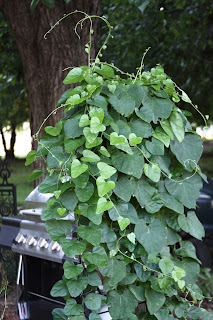
Not everyone can stomach watching caterpillars eat their garden plants. For many of us it is one of the thrills of summertime garden walks. Nectar plants provide food for adult butterflies and we have plenty of those. Host plants are where the butterflies raise their babies. The eggs must hatch on plants that the caterpillars can eat and adults only lay eggs on those plants. Here are some of the plants we grow just so they can be eaten by caterpillars - can you identify the butterflies that use them for host plants? Dutchman's Pipevine Passionflower vines Spicebush Rue Milkweed Balloon milkweed Swamp milkweed Dill Fennel

American Bluehearts are hemi-parasitic Buchnera americana

Image
Plants.usda.gov American bluehearts are native to about half of the US, from TX, OK and KS east to NY and FL, usually along wet places and in limestone and sand as well as open woods. It is important to know what they look like so we don't inadvertently speed up their extinction. They are considered threatened and endangered now. The distinction hemi-parasitic means they are able to grow independently without a host but grow best when attached by parasitic roots called haustoria. During droughts they tend to multiply their activity to the extent that they can actually damage small trees. Bluehearts favorite hosts are white oak, eastern white pine, green ash and cottonwood. Buckeye butterfly caterpillars use American Bluehearts as a host plant. Click over to this post on the Arkansas Native Plant Society to read more about these fascinating plants - by Eric Hunt.

Ruellia brittoniana is Dwarf Mexican Petunia

Image
Ruellia brittoniana Dwarf Mexican Petunia For the front of a summer and fall flower bed, I've found pink flowering dwarf Mexican Petunia,  Ruellia brittoniana.  Started from seed a couple of winters ago, ours bloom intermittently for several months. Those dark green leaves persist for several months Part of the reason ours bloom so little is that they are in too much shade. The plants grow a foot tall. They are cold hardy in zones 7 to 10 only. The plants are host food for the Common Buckeye butterfly caterpillars and the flowers are a nectar source for most local butterflies. Ball Seed has some interesting information about them. They call them Ruellia Southern Star Pink and also have pink and white flowering varieties. Outside Pride calls them Southern Star Ruellia and like many references suggests that they can become invasive. Mine have not moved an inch nor sprouted from seed anyplace other than where I placed them two years ago. The tall, purple flowe...

Pawpaw, Asimina triloba, loved by Zebra Swallowtail Butterflies

Image
The flowers of Pawpaw, Asimina triloba, are downward facing so you have to keep an eye out for them or you will miss their sweet beauty in the spring. Ours is blooming now and has been for the past 2 weeks.   In order to get fruit, you have to have 2 cultivars. We don't care about fruit since we planted the tree solely for the zebra swallowtail butterfly's visits. For our purpose a seed started tree was just fine. For fruit, look for grafted cultivars.   Some protection from the worst of summer's sun and excellent drainage are critical to their success. Since it is a small tree, ours is in the herb bed with a bird bath and a few native plants.           KY State University Pawpaw Planting Guide is at this link   Excerpts- "The pawpaw is a tree of temperate humid growing zones, requiring warm to hot summers, mild to cold winters, and a minimum of 32 inches (81 cm) of rainfall spread rather evenly throughout the year...

Bring Butterflies, Skippers and Moths to Your Garden

Image
Many people love the sight of butterflies, moths and skippers in their garden. Planning ahead can help bring more this summer. Carole Sevilla Brown recently posted a list of five actions to take to improve your butterfly gardening and it's an important place to start. Brown's blog entry is at http://www.beautifulwildlifegarden.com/5-steps-to-butterfly-garden.html Maybe you have some ideas that work for you. We'd love to hear those since we always want more! Start Here Find out what kind of butterflies, moths and skippers are common or native to your neck of the woods so you can plant what they raise their babies (caterpillars or larvae) on. When these insects are born in your garden they tend to stick around and make a few new generations as long as the food lasts.  Butterfly weed - Asclepias tuberosa Mass planting instead of spot planting is a great suggestion from Brown's blog. A single zinnia here and there will bring a single adult butterfl...

Grey Hairstreak Butterfly (Strymon melinus) has Pink Caterpillar

Image
Grey Hairstreak Butterflies are fairly common here in North America. Gray Hairstreaks fly throughout the US, north to southern Canada, South to Mexico and Venezuela. Their caterpillars eat many many plants but do the most crop damage to beans and cotton. Favorite caterpillar foods include anything in the pea family (Fabaceae), mallows Malvaceae and Malva), beans (Phaseolus), clovers (Trifolium), and cotton varieties Gossypium). Project Noah Not all Hairstreak caterpillars are pink - some are the usual colors: beige, bright green, brownish, etc. But check out this guy - he's positively pink! Shady Oak Butterfly Farm posted a photo of the pink caterpillar on their Facebook page today. http://www.facebook.com/#!/ShadyOakButterflyFarm I've had hundreds of Gray Hairstreaks in our garden over the years and I have yet to see a pink caterpillar. I will be positively vigilant this coming butterfly season! Their flights are May-September in the north and in the south they have t...